
Glucosamine sulphate
The form most commonly studied in joint comfort research, usually paired with a mineral salt. Heavier by weight, so an equivalent quantity can look larger on a label than the hydrochloride version.
Choosing a formula · UK register
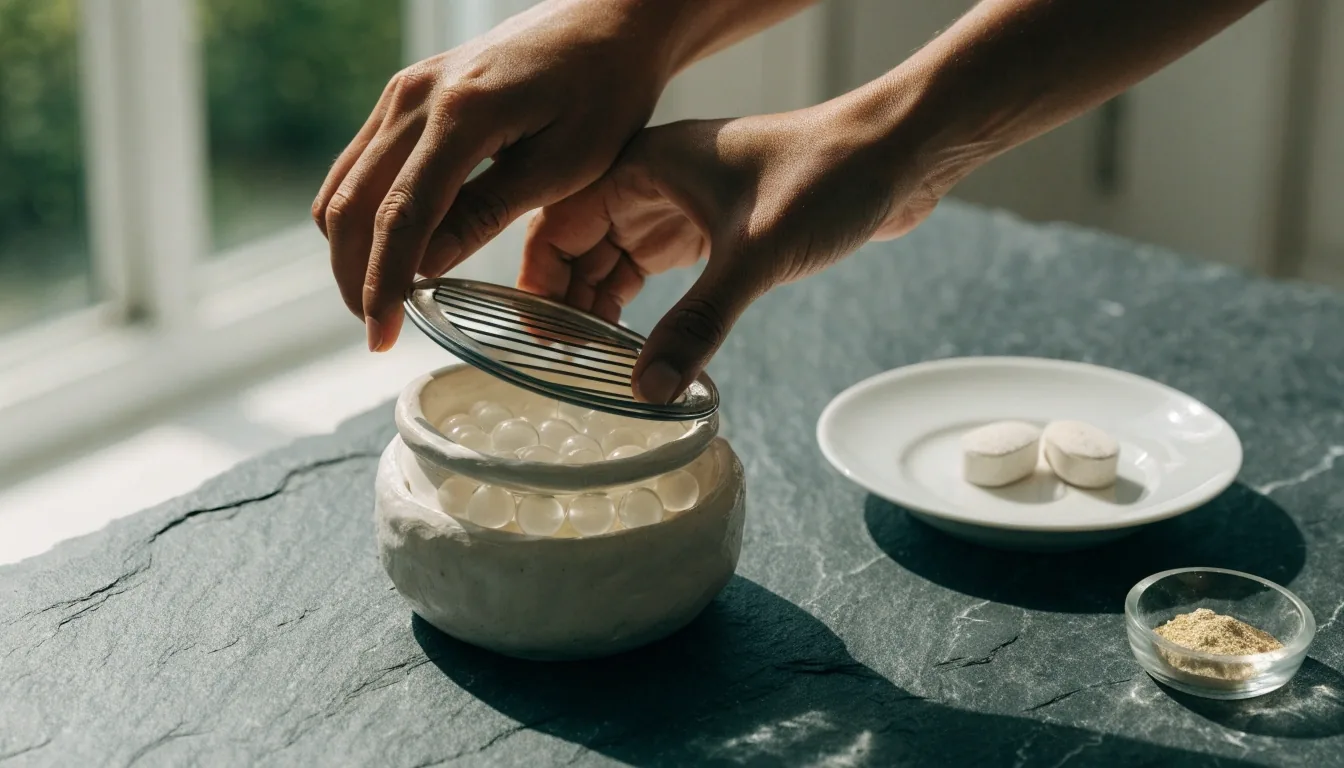
Picking a joint capsule comes down to a handful of practical questions. What is in it, how much you take in a day, and whether it fits the way you already live. Work through those in order and the choice gets much simpler.
This page is the decision rail for that. Read the daily serving before anything else, name the actives, choose a format your morning can carry, then set a date to review how the routine sits.
Written as general product information for UK readers. Nothing here stands in for advice from a qualified professional.
This is the detail that decides most purchases, and it is the one people skip. Some joint capsules are one a day, others are two or three. The amount of each active is listed per serving, not per capsule. So a blend that reads as generous on the front can turn out to be a smaller daily intake than a plain single-capsule product sitting next to it.
Find the daily serving before you read anything else on the label. In the UK, the supplement information panel carries the serving line and the quantity for each ingredient at that serving. Two numbers to note: how many capsules make a serving, and how much of each named active that serving contains. Everything after that is comparison.
If you want a routine that supports daily joint comfort, this single step does more work than any wording on the front of a box. It also settles the running-cost question early: a two-a-day jar empties in half the time of a one-a-day jar at the same capsule count.
Glucosamine sulphate and glucosamine hydrochloride are not identical. Chondroitin can be bovine or marine. Turmeric may or may not arrive with black pepper extract. These differences matter more than the marketing language around them, and they are the fastest thing to check across a shortlist of natural joint care capsules.
The form most commonly studied in joint comfort research, usually paired with a mineral salt. Heavier by weight, so an equivalent quantity can look larger on a label than the hydrochloride version.
A lighter form with more glucosamine per gram of powder. Useful when a capsule needs to stay compact.
Origin changes the allergen picture as much as the formula. Shellfish-free formulas almost always name a bovine source.
Many broad blends pair turmeric with black pepper extract and name it. If the pairing is unstated, ask before you buy.
A label that names its sources clearly is usually a label that has thought about the formula. If two products look identical on the front and differ on the back, the back is the one to trust.
A compact formula built around glucosamine, MSM and vitamin C gives you a clear, targeted routine. A broad blend that adds turmeric, collagen and hyaluronic acid covers more ground in one container. Neither is better than the other, and neither restores joint health on its own. What matters is which one you will still be taking in eight weeks.
Focused suits people who already know what they want and would rather keep the daily act short. Broad suits people who would rather not juggle three containers and a scoop before breakfast. If you are unsure, the capsule comparison lays the same formulas side by side so you can see what is actually in each one.
Compare UK formulas
Keep your own ruled log for the first weeks. A written line each day is easier to read back than memory.
Format is the most underrated part of the decision. It decides whether the product survives a real Tuesday. Four options do most of the work, and each one has a cost that only shows up in the first week.
Travel well and are easy to swallow. The usual choice for joint capsules taken away from the kitchen.
Best on the move
Often carry larger quantities in a single unit, which can mean fewer units per day for a bigger serving.
Bigger serving
Need a drink and a minute at the counter. Fine at home, awkward on an early train.
Home routine
The simplest option if swallowing a capsule is awkward. Check the serving volume before you commit to a bottle.
Easiest to take
If you leave the house before seven, that fact alone may rule out powders. If your mornings are unhurried, the powder you mix at the counter is often the cheapest route to a larger serving. Choose against your real week, not your ideal one.
A good label tells you what is in the product and how much. It does not need to promise anything, and the louder ones usually have less to say. If the quantities are hidden behind a proprietary blend, or the wording is stronger than the ingredient list, that is a reason to look elsewhere. The UK market has plenty of clear options, including natural leg capsules built around a short, named ingredient set.
The same test applies to an effective joint remedy of any kind: the back of the container should answer your questions without you having to search for a certificate or a footnote.
These are not the exciting lines on a label, but they are the ones that decide whether the container ever gets finished. Read them before the price.
Decide in advance when you will judge the routine. Six weeks is a common first look; two months suits people who would rather not check too often. Note how you feel today, on paper, so you have something real to compare against later.
Without a review point, people either stop too early because nothing feels different yet, or keep going on autopilot because stopping takes a decision. A date in the calendar fixes both, and it costs nothing. If you are building the routine from scratch, the daily routine guide covers the movement and timing side of the same habit.
Read the routine guideA first eight weeks
A filled cell means the day went the way you planned. Empty days are information too, not failures. Three weeks of clear cells is a fair point to read back.
Start with the one you can keep taking. If your mornings are simple and you like a short routine, a focused formula keeps the decision small. If you would rather not manage three containers, a broad blend spreads the same job across one bottle. Neither route is quicker than the other, and neither works unless the container actually empties.
Set the point yourself before you start, and write down how you feel on day one. Six weeks is a common first look, two months a common second. What matters is that the review happens on a date you chose rather than on a morning when you happen to feel impatient.
No. Compare the quantity per daily serving, then check how many capsules that serving takes. A lower number behind a single capsule can be easier to keep up than a higher number split across three, and the label will tell you which is which if you read the serving line first.
That is a question for a qualified professional rather than a label. If you already take something else, or you are unsure how two formulas overlap, ask before you add a second container to the shelf. Our contact page is the place to send that question.
Serving size, named actives, format, then a review date. Four steps, and you have a shortlist you can actually compare rather than a shelf of similar-looking jars. If you would rather read the same four steps against real formulas, the comparison page lays them out side by side.
Northstride Joint Comfort
48 Fitzroy Road, London NW1 8TU, United Kingdom
Phone: +44 161 489 3659
Email: [email protected]
Monday to Friday, 9:00 AM – 6:00 PM
General product information for readers in the United Kingdom. This page does not offer personal advice; speak to a qualified professional if you are unsure what suits you.